Wind Powers a Fifth of Europe as Capacity Reaches 304GW
25 Mar, 20264 MINStrong Growth in 2025 but Permitting Delays and Grid Constraints Hold Back Full PotentialEur...

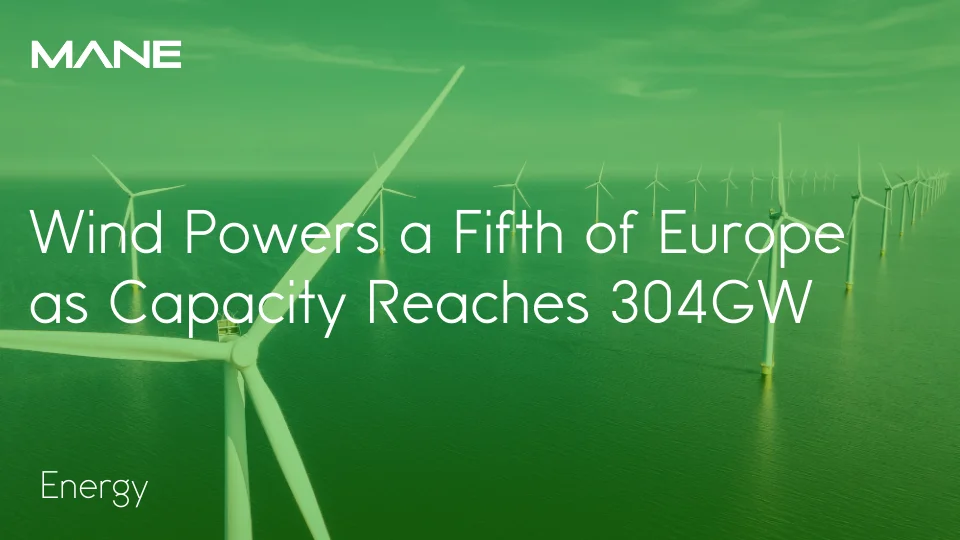
Strong Growth in 2025 but Permitting Delays and Grid Constraints Hold Back Full Potential
Europe's wind sector delivered another year of solid expansion in 2025, adding 19.1 gigawatts of new capacity and lifting total installed wind power to 304 gigawatts across the continent. According to the latest figures from WindEurope, wind energy now accounts for around a fifth of electricity demand across Europe including the UK, a milestone that reflects more than a decade of sustained investment and policy commitment. The United Kingdom contributed approximately 1.3 gigawatts of new capacity to that total, with wind supplying around 31% of UK electricity generation over the course of the year.
Denmark retained its position at the top of the European penetration league table, with wind supplying roughly half of national electricity demand, underscoring what is possible when a consistent long-term policy framework is combined with the right geography and grid infrastructure. Germany led Europe in absolute terms for new installations, followed by Turkey and Sweden. The diversity of high-performing markets reflects the extent to which wind energy has moved from a niche technology to a mainstream component of power systems across the continent.
Onshore Dominates, Offshore Slows
The composition of new capacity in 2025 tells an important story about where the sector currently faces its greatest challenges. Onshore wind accounted for approximately 90% of new installations during the year, as offshore development slowed in the face of higher costs, grid connection constraints, and delayed projects that have pushed completion timelines further into the decade. The slowdown in offshore is not a signal of diminished ambition but of the practical and financial obstacles that have accumulated in recent years, including supply chain inflation, rising capital costs, and the protracted permitting processes that continue to add years to project development timelines.
Despite the strong addition of new capacity, overall wind generation in 2025 rose only modestly to around 465 terawatt-hours. WindEurope attributes this in part to weaker wind conditions across some European markets and in part to persistent curtailment in areas where grid infrastructure has not kept pace with generation capacity. The gap between installed capacity and actual generation output is a reminder that building turbines is only one part of a functioning wind energy system; the grid, the connections, and the market design all matter equally.
The Gap Between Ambition and Delivery
The WindEurope report draws attention to a widening divergence between what governments have committed to and what the sector is actually delivering. Europe auctioned 29.4 gigawatts of new wind capacity in 2025, a figure that was down on the previous year and that continues to fall short of the volumes required to meet climate and energy security targets. Permitting delays remain a structural brake on deployment across most European markets, with project development timelines that frequently stretch to a decade or more between initial planning applications and first power generation.
The UK is not immune to these pressures. Despite a strong resource base and established industry expertise, England in particular faces significant friction from grid connection queues, planning processes, and the time required to secure the network reinforcements needed to bring new projects online. Scotland's pipeline is more advanced, benefiting from clearer grid access in some locations and a stronger consenting track record for certain project types, but even here the infrastructure investment required to move power south is a growing constraint.
WindEurope projects that installations will accelerate from 2026 onwards, with an average of around 30 gigawatts of new capacity added each year between 2026 and 2030. If this trajectory is achieved, total installed capacity would reach approximately 439 gigawatts by the end of the decade, split between around 366 gigawatts onshore and 73 gigawatts offshore. That expansion is described by WindEurope as critical to meeting electricity demand that is rising across all sectors as transport, heating, and industry progressively electrify.
Repowering and the Ageing Fleet
One of the more significant themes in the WindEurope report concerns the growing importance of repowering as Europe's earliest wind installations approach or reach the end of their operational lives. Replacing older, smaller turbines with fewer but significantly more productive modern machines could deliver substantially more output using existing sites and grid connections, avoiding the need for new planning applications and network upgrades in areas where capacity is already established.
The economics of repowering are compelling, and the environmental logic is strong. However, WindEurope notes that planning rules across many European markets have not kept pace with this reality, creating regulatory friction that slows or prevents repowering projects that would deliver clear public benefit. Reforming the planning and permitting framework for repowering, alongside new-build consenting, is increasingly recognised as a priority for governments seeking to maximise the contribution of wind energy to their power systems.
The Impact on Hiring
The wind sector's growth trajectory, combined with the urgency of addressing grid constraints, permitting delays, and the repowering challenge, is generating sustained and diversified demand for skilled professionals across the UK. Recruitment agencies placing engineers, project developers, and technical specialists in the renewable energy sector are operating in a market where demand consistently exceeds supply, and where the range of roles required has expanded significantly beyond the turbine technician and wind resource analyst positions that defined the sector's early hiring needs.
Grid connection and network engineering expertise has become one of the most sought-after capability areas across the wind sector. As curtailment and connection delays become central constraints on project viability, organisations are investing in the teams needed to navigate grid access processes, engage with National Grid and distribution network operators, and develop the technical solutions required to bring projects to the point of connection efficiently. Candidates with this background are in particularly high demand and short supply.
Offshore wind's recovery from the cost and supply chain pressures of recent years is creating a fresh wave of hiring activity as projects delayed in 2024 and 2025 move back into active development. Project managers, procurement specialists, marine engineers, and commissioning professionals will all be in demand as the offshore pipeline accelerates towards 2030. Recruitment in this space requires an understanding of both the technical requirements of offshore project delivery and the commercial pressures that organisations in the supply chain are navigating.
The repowering opportunity is also beginning to generate specific hiring demand. Organisations with early-generation wind assets are building or expanding the teams needed to assess repowering feasibility, manage planning processes, negotiate with landowners and grid operators, and oversee the physical replacement of turbine assets. This is a relatively new area of activity that draws on a combination of project development, engineering, and regulatory expertise, and specialist recruitment support is increasingly valuable in helping organisations assemble the right teams.
Looking Ahead
Wind energy's contribution to European and UK electricity supply will continue to grow over the coming decade, driven by new installations, improved turbine performance, and the progressive repowering of ageing assets. The 304 gigawatts already installed across Europe represents a substantial foundation, but the sector's ability to meet the ambitions set for it depends on resolving the structural bottlenecks that are currently constraining delivery.
Faster permitting, stronger grid investment, and more consistent auction pipelines are the policy priorities that WindEurope has identified as essential. Alongside these, the sector needs a workforce capable of developing, building, connecting, and operating the assets required to reach 439 gigawatts by 2030. The hiring challenge is real and it is growing. Organisations that invest in building strong talent pipelines now will be better positioned to capitalise on the opportunities ahead than those that wait for the market to resolve itself.
Related Posts
When the Thermometer Becomes an Energy Problem
18 Aug, 2026

When the Grid Strains, the Talent War Heats Up
25 Jun, 2026